The World and All the Things Upon It David Chang Reviews
AWARDS:
-Modern Language Association's Prize for Studies in Native American Literatures, Cultures, and Languages
-American Historical Association's Albert J. Beveridge Award
-NAISA All-time Subsequent Book Laurels
-Western History Association John C. Ewers Award (for best book in North American Indian Ethnohistory)
-John Hope Franklin Prize (finalist)
Centering indigenous perspectives on the age of exploration
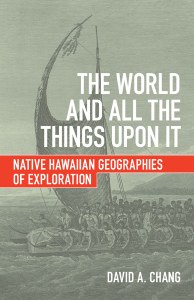
The World and All the Things upon It traces how Kānaka Maoli (Native Hawaiian people) explored the outside world and generated their own understandings of information technology in the century after James Cook'due south inflow in 1778. David A. Chang examines travel, sexuality, spirituality, print culture, gender, labor, educational activity, and race to shed calorie-free on how Hawaiians, as well as their would-exist colonizers, perceived and contested imperialism, colonialism, and nationalism.
"In The World and All the Things upon It, David A. Chang places Hawai'i, both literally and figuratively, at the center of the world. His fascinating explorations of Kānaka Maoli histories throughout the nineteenth-century Pacific puts Hawaiian studies in powerful conversation with some of the most exciting and chop-chop irresolute fields of historical inquiry across this vast region."—Coll Thrush, author of Ethnic London: Native Travellers at the Heart of Empire
What if we saw indigenous people equally the active agents of global exploration rather than as the passive objects of that exploration? What if, instead of conceiving of global exploration every bit an enterprise but of European men such as Columbus or Cook or Magellan, nosotros thought of it every bit an enterprise of the people they "discovered"? What could such a new perspective reveal about geographical agreement and its identify in struggles over power in the context of colonialism?
The World and All the Things upon Information technology addresses these questions by tracing how Kānaka Maoli (Native Hawaiian people) explored the outside globe and generated their ain understandings of it in the century after James Cook's arrival in 1778. Writing with verve, David A. Chang draws on the compelling words of long-ignored Hawaiian-language sources—stories, songs, chants, and political prose—to demonstrate how Native Hawaiian people worked to influence their metaphorical "place in the earth." We meet, for example, Kaʻiana, a Hawaiian primary who took an English captain as his lover and, while sailing throughout the Pacific, considered how Chinese, Filipinos, Pacific Islanders, and Native Americans might shape relations with Westerners to their ain advantage. Chang'south book is unique in examining travel, sexuality, spirituality, print civilization, gender, labor, teaching, and race to shed light on how constructions of global geography became a site through which Hawaiians, every bit well as their would-be colonizers, perceived and contested imperialism, colonialism, and nationalism.
Rarely have historians asked how not-Western people imagined and fifty-fifty forged their ain geographies of their colonizers and the broader globe. This volume takes upwardly that task. It emphasizes, moreover, that there is no ameliorate style to understand the process and meaning of global exploration than by looking out from the shores of a place, such equally Hawaiʻi, that was allegedly the object, and not the agent, of exploration.
Awards
Modernistic Language Clan'due south Prize for Studies in Native American Literatures, Cultures, and Languages
American Historical Association's Albert J. Beveridge Award
NAISA Best Subsequent Book Accolade
Western History Association John C. Ewers Honour (for best book in Due north American Indian Ethnohistory)
John Hope Franklin Prize (finalist)
In The World and All the Things upon Information technology, David A. Chang places Hawai'i, both literally and figuratively, at the center of the world. His fascinating explorations of Kānaka Maoli histories throughout the nineteenth-century Pacific puts Hawaiian studies in powerful conversation with some of the about exciting and rapidly changing fields of historical inquiry beyond this vast region.
—
Coll Thrush, author of Indigenous London: Native Travellers at the Eye of Empire
David A. Chang's research and assay is fresh and makes an outstanding and vital contribution to our knowledge. The World and All the Things upon It is a piece of work of aloha 'āina, honey of the land and our native people.
—
Noenoe Silva, Academy of Hawai'i
Chang not only provides a voice to the history of the Hawaiian people, he also enriches the understanding of earth history and global exploration by revealing ways that local peoples globalized their ain world. Highly recommended.
Chang's piece of work adds to the growing studies of indigenous geographies and to the fields of Hawaiian history and earth history, challenging readers to rethink global encounters by centering such encounters on the perspectives and systems of knowledge of Kanaka Maoli.
—
Journal of Native American and Ethnic Studies (NAIS)
Chang makes arguments that are supported by stiff inquiry. Chang identifies his book as belonging to role of a larger group of scholars similar Noenoe Silva who are pushing against the traditional colonial versions of history that focus on the colonizer.
—
Pacific Historical Review
Contents
Introduction: Making Native Hawaiian Global Geographies
ane. Looking Out from Hawaiʻi's Shore: The Exploration of the Earth Is the Inheritance of Native Hawaiians
2. Paddling Out to Run across: Direct Exploration by Kānaka in the Late Eighteenth Century
3. A New Religion from Kahiki: Christianity, Textuality, and Exploration, 1820–1832
4. The World and All the Things upon It: Geography Education and Textbooks in Hawaiʻi, 1831–1878
5. Hawaiian Indians and Blackness Kanakas: Racial Trajectories of Diasporic Kanaka Laborers
6. Bone of Our Bone: The Geography of Sacred Ability, 1850s–1870s
7. "Nosotros Will Exist Comparable to the Indian Peoples": Recognizing Likeness between Kānaka and American Indians, 1832–1895
Epilogue: Genealogies of the Nowadays in Occupied Hawaiʻi
Acknowledgments
Notes
Source: https://www.upress.umn.edu/book-division/books/the-world-and-all-the-things-upon-it
0 Response to "The World and All the Things Upon It David Chang Reviews"
Post a Comment