How Soon After Having a Baby Can I Return to Work
Is twoscore Weeks the Ideal Maternity Leave Length?
Long leaves are adept for both babies and mothers, merely actress-long leaves may non be, and other surprising lessons from Europe.
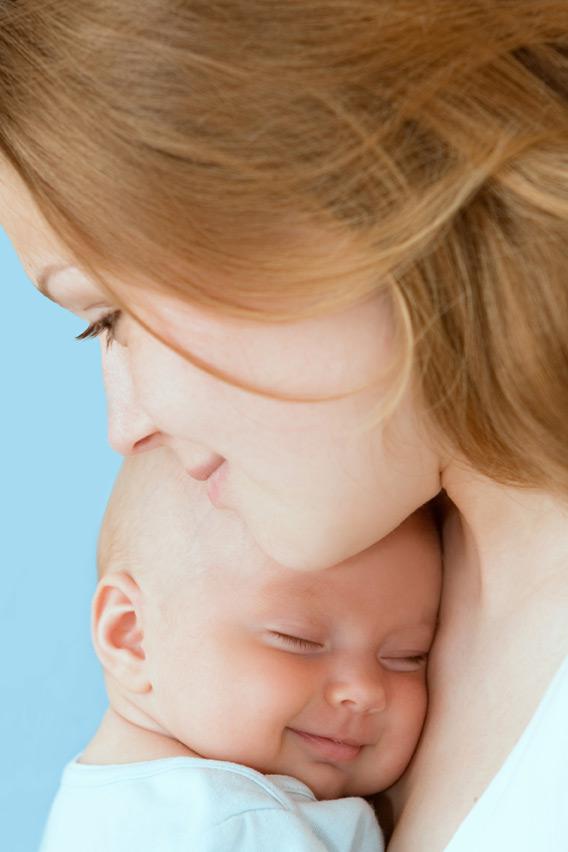
Photograph past Chad Baker/Ryan McVay.
How long do working mothers stay home afterwards having their get-go child? If you guessed the respond might exist 12 weeks (not an unreasonable assumption, since that'south the amount of time allotted by our national family exit law), you'd be sadly mistaken. Co-ordinate to recently released census numbers, a bulk of mothers who worked during pregnancy go back before that, some way before. More than than a quarter are at work within two months of giving birth and ane in 10—more half a meg women each year—get back to their jobs in 4 weeks or less.
Permit's take a moment to think about what'southward going on just four weeks subsequently birth. Babies haven't even cracked their first real smiles all the same. Mothers are still physically recovering from birth, particularly if they've had C-sections. They're both probably getting upwards several times during the night to nurse. In fact, they've barely begun what'due south supposed to be half a year of sectional chest-feeding, co-ordinate to the American Academy of Pediatrics.
Yet going back to work in such a brusk corporeality of time isn't simply tiring or unpleasant, new research demonstrates that it's bad for both women and children. We now accept enough testify to arraign the short amounts of fourth dimension mothers have with newborns for developmental delays, sickness, and even death. (I say mothers because, while near leave laws apply to men and women, women are far more probable than men to accept time off and, thus, are the subjects of most inquiry.)
And so leaving bated for a moment the astern politics in the United States that leave united states without any paid fourth dimension off, what does this growing body of knowledge tell us about how much time would actually be optimal? Some of the results are surprising. For ane affair, there is some evidence that very long leaves have an economic and professional downside for women, and at best a neutral effect on children. Then it's not simply that more time off is better. Rather, certain amounts of leave may give the biggest bang, while longer periods of leave may yield diminishing returns, at best.
By looking to Europe, which has meticulous data collection practices and a history of paid leave stretching back to the 19th century, researchers have been getting a better and improve handle on the extent to which varying amounts of paid go out can salve kids' lives. Two studies, i published in the Economic Journal in 2005 and another five years earlier, examined the results of the steady climb in paid go out in 16 European countries, starting in 1969. Past charting expiry rates against those historical changes, while controlling for wellness care spending, health insurance, and wealth, the authors were able to attribute a 20 percent dip in infant deaths to a 10-calendar week extension in paid leave. The biggest drop was in deaths of babies between 2 and 12 months, but deaths between 1 and 5 years too went downwardly equally paid exit went upwards. So what was the optimal corporeality of time off, according to all this research? According to Christopher Ruhm, the author of the first European written report, paid exit of most 40 weeks saved the almost lives. (After that point, according to Ruhm, "in that location may even exist some partial reversal of those gains.")
Hither in the United States, the few paid get out programs we have may be too small to brand much of a difference, as the authors of a report published this calendar month suggested after being unable to discover any impact of state go out policies on children's health. Efforts to study paid exit in this state are further complicated by the fact that those American parents who practise get paid time off oft tend to exist lucky in other ways, too. That recent census report shows that simply 18 percent of mothers with less than a high school pedagogy got paid time off compared with 66 percent of women with at least a available's degree. This makes it difficult to know whether differences between American families in which a parent was able to stay home and families in which the mother went correct back to piece of work might instead be attributable to poverty, pedagogy, or other factors.
Turning our optics dorsum to Europe, there is evidence that leave—fifty-fifty when it's shorter than that apparently platonic xl-calendar week span identified past Ruhm—has not just health effects but measurable developmental and behavioral benefits, besides. One written report tracked Norwegian children who were born subsequently 1977, when that country increased its paid leave from zippo to iv months and its unpaid leave from iii to 12 months, and found that the kids born after the change had lower high school dropout rates. Military draft data, moreover, tied lengthened leaves to increases in male IQ (and height, too).
It's not entirely clear why having parents around would help babies grow taller or smarter, or alive long longer, but the inquiry points to a few potential advantages to kids whose mothers stay home for at least 3 months. In another report published in the Economical Journal in 2005, American babies whose mothers were back at work within 12 weeks were less likely to get doctors' visits and immunizations and be chest-fed. All this makes intuitive sense, of course: Checkups tin help diagnose and treat illnesses, but they are hard to schedule when y'all're working. And while exclusive breast-feeding for at least six months has been shown to prevent respiratory infections, bacterial meningitis, and other illnesses, going dorsum to work tin brand information technology difficult if non impossible.
In the developmental realm, the benefits of leave may be trickier to explain. That 2005 Economic Periodical written report of American women who returned to work within 12 weeks showed that infants whose mothers went dorsum even earlier were likely to accept more behavioral problems and lower cognitive exam scores at age iv. The authors speculated that the difference might take stemmed from the superior care babies receive from parents, as opposed to other caregivers. It might too take something to practice with attunement, the crucial developmental process through which parent and newborn adjust to each other.
But what about those parents—nigh of whom are mothers? What do we know about what the ideal length of leave fourth dimension might be for them? In terms of American mothers' mental health, the best respond for now may be merely: more than. Numerous studies have tied the lack of fourth dimension off to depression in working mothers. Conversely, a 2004 study plant that an increase of just one week of fourth dimension off decreased the number and frequency of symptoms of depression in American mothers.
Information technology's like shooting fish in a barrel to empathise why an American woman going back to work just four, eight, or even 12 weeks after birth might get depressed—particularly if she looks to Europe, where at to the lowest degree vi months of paid leave is the norm and several countries grant more three years.
Perhaps we American women can cheer ourselves with the several recent studies that have failed to find benefits of such very long leaves. It turns out that the increase from 12 to 15 months of paid leave—which Sweden made dorsum in 1988—doesn't have a dramatic result on kids. There is even some evidence that laws granting more a yr and a half off paid tin hinder women'due south professional achievement. It may exist cold comfort, just at least this is one trouble that we American mothers, facing the prospect of caring for new babies while somehow holding onto our jobs, just don't take.
Source: https://slate.com/human-interest/2011/12/maternity-leave-how-much-time-off-is-healthiest-for-babies-and-mothers.html
0 Response to "How Soon After Having a Baby Can I Return to Work"
Post a Comment